
On July 1st, it will be 80 years since the first American nuclear detonation in the Marshall Islands. July 2nd will be 60 years since the first French detonation at Mururoa Atoll in Mā’ohi Nui.
80 years on from the first of some 300 nuclear explosions conducted in the Pacific, the impact on the fragile ecology of the region and the health and mental well-being of its peoples has been profound and long-lasting. The ‘testing’ on First Nations land in Australia at Maralinga, Emu Field and the Monte Bello Islands, and across the Pacific, including in the Marshall Islands, Kiribati and Mā’ohi Nui (French Occupied Polynesia) has left behind radioactive legacies felt far beyond borders.
This Pacific Peace Pilgrimage will shine a light on the history and intergenerational impacts of nuclear ‘testing’ in the Pacific region, including here in Australia. ICAN Australia is working with The Quakers and the Pacific Conference of Churches to welcome nuclear-impacted communties from the Pacific and Australia for a series of events which will highlight pathways towards nuclear justice in the region and call for a future that is decolonised, demilitarised, denuclearised and decarbonised.
Nuclear detonations in the Pacific: 80 years on
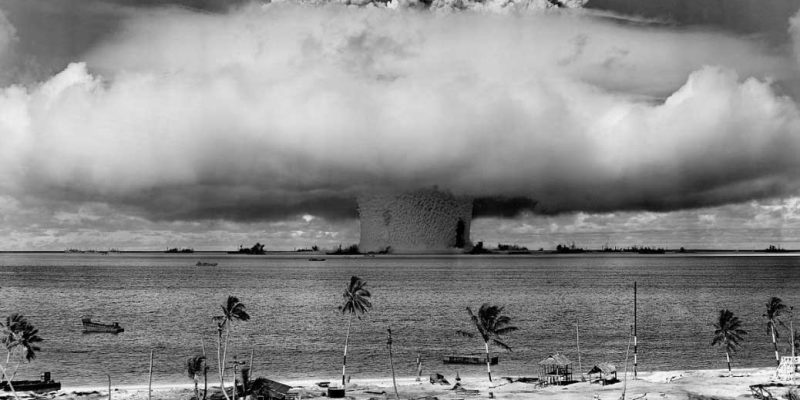
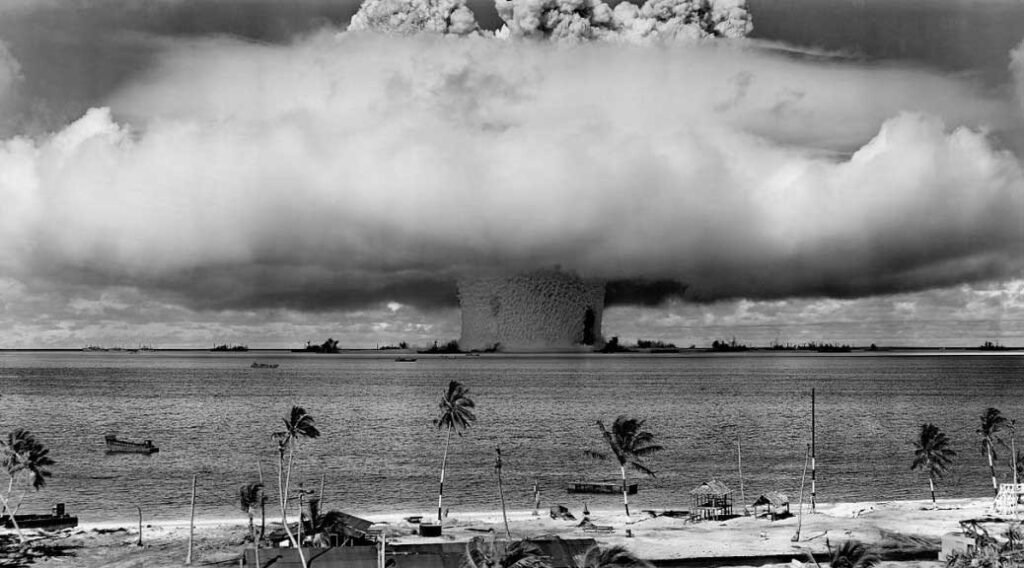
From the beginning of the nuclear age, Pacific islands have been used for the development and proliferation of nuclear weapons. The plane Enola Gay left the Micronesian island of Tinian to carry the atomic bomb to Hiroshima, Japan, in August 1945. The following year, the United States began testing nuclear weapons in the Marshall Islands
On July 1st, it will be 80 years since the first American nuclear detonation in the Marshall Islands. July 2nd will be 60 years since the first French detonation at Mururoa Atoll in Mā’ohi Nui.
Over the next five decades, more than 315 nuclear test explosions were conducted across the region by France, Britain and the United States. Seeking ’empty’ spaces, the Western powers chose to conduct cold war programmes of nuclear ‘testing’ in the deserts of central Australia or the isolated atolls of the central and south Pacific.
The impacts of these detonations and all that followed were catastrophic. But the nuclear threat isn’t only historical. The continued existence of nuclear weapons, that are carried through continents and oceans continue a threat throughout the Pacific.
Join a pilgrimage between July 1 and 3, in Canberra, Sydney and Melbourne.
- July 1: Morning Vigil, Parliament Lawns, Ngunnawal & Ngambri Country / Canberra
- July 2: Public Event: Quaker Centre, Ngunnawal & Ngambri Country / Canberra
- July 3: Public Event, Rainbow Warrior House, Gadigal Country / Sydney
- July 3: Public Event, Balam Balam Place, Wurundjeri Country / Melbourne
Over the next five decades, more than 315 nuclear test explosions were conducted across the region by France, Britain and the United States. Seeking ’empty’ spaces, the Western powers chose to conduct cold war programmes of nuclear ‘testing’ in the deserts of central Australia or the isolated atolls of the central and south Pacific.
The impacts of these detonations and all that followed were catastrophic. But the nuclear threat isn’t only historical. The continued existence of nuclear weapons, that are carried through continents and oceans continue a threat throughout the Pacific.
80 years on from the first of some 300 nuclear explosions conducted in the Pacific, the impact on the fragile ecology of the region and the health and mental well-being of its peoples has been profound and long-lasting. The ‘testing’ on First Nations land in Australia at Maralinga, Emu Field and the Monte Bello Islands, and across the Pacific, including in the Marshall Islands, Kiribati and Mā’ohi Nui (French Occupied Polynesia) has left behind radioactive legacies felt far beyond borders.
This Pacific Peace Pilgrimage will shine a light on the history and intergenerational impacts of nuclear ‘testing’ in the Pacific region, including here in Australia.
ICAN Australia is working with The Quakers and the Pacific Conference of Churches to welcome nuclear-impacted communties from the Pacific and Australia for a series of events which will highlight pathways towards nuclear justice in the region and call for a future that is decolonised, demilitarised, denuclearised and decarbonised.
SafeGround supports this initiative.