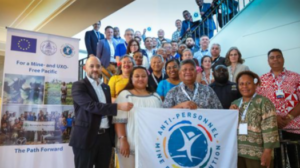

From September 7-9, Mette Eliseussen of SafeGround and Maeverlyn Pitanoe of Bomb Free Solomon Islands attended the Regional Stakeholder Dialogue on the Implementation of the Convention on Anti-Personnel Mines in the Pacific: Aligning with the 2050 Strategy for the Blue Pacific Continent and Regional Security Agenda.
The Regional Stakeholder Dialogue was hosted by the Ministry of State of Palau, with support provided through a European Union Council Decision to support implementation of the Convention and technical backing from the ISU.
The Dialogue provided a practical forum for Pacific States Parties to exchange experiences on implementation of the Convention, including national implementation measures, cooperation and assistance, and residual contamination management. It also offered an opportunity to explore synergies with related humanitarian disarmament instruments and regional priorities in the Pacific.
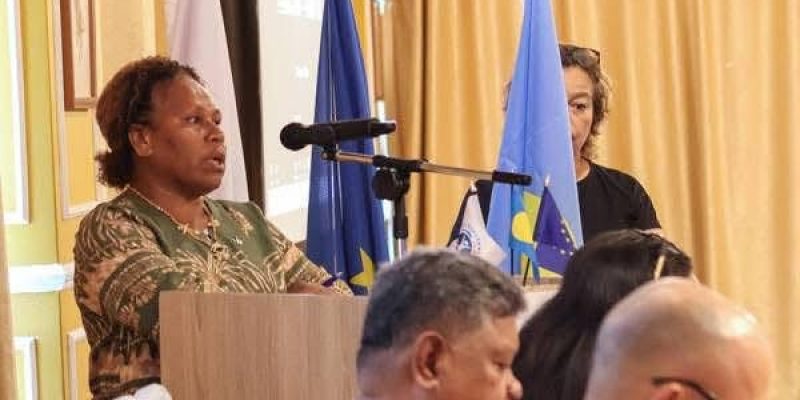
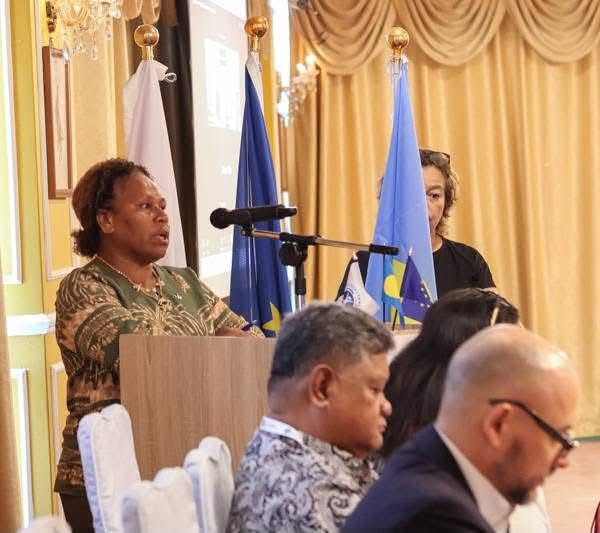
Below is the address by Maeverlyn Pittanoe to MBT Pacific Regional Stakeholder Dialogue, the speech delivered by Maeverlyn Pitanoe of Bomb Free Solomon Islands on September 8, 2026. The Regional Stakeholder Dialogue was held in Koror, Palau, from 7–9 September.
From Survivor to Advocate: Address by Maeverlyn Pitanoe to MBT Pacific Regional Stakeholder Dialogue
Distinguished delegates, fellow Pacific representatives, colleagues, and friends, good morning. It is an honour to stand before you and share my perspective as a UXO survivor and the Founder and Chairperson of Bomb Free Solomon Islands.
Thank you for giving me the opportunity to share something very personal with you today.
I stand before you not only as the Founder of Bomb Free Solomon Islands, but as a survivor of a UXO explosion.
Before I became an advocate, before I founded BFSI, I was a woman who survived a UXO explosion.
And that is where my story begins.
On 9 May 2021, during a youth fundraising event in my community, we were cooking together on open fire. It was a beautiful day—people were together, there was laughter, and we were doing something positive for our community.
Then, in a single moment, that joy became tragedy.
A bomb exploded underneath our cooking fire.
Two of my best friends and youth leaders lost their lives, and I was left extensively burned and severely injured, carrying physical scars and consequences that I continue to live with today.
That moment changed everything.
I spent 53 days in hospital. My recovery was long and difficult. But I soon realised that surviving the explosion was only the beginning.
There were physical consequences.
There were emotional consequences.
There were financial consequences.
There were changes in what I could do, and painful questions about what my future would look like. Before the explosion, I had a well-paid and a meaningful career at the Solomon Islands National University. I had earned a Master’s degree in Educational Leadership and was working as a Monitoring and Evaluation Officer. But the impacts of my injuries changed everything. Despite my qualifications, experience, and commitment to my work, I eventually had to leave the job I had built my career around—not because I had lost my ability or ambition, but because the physical and emotional consequences of the explosion made it impossible for me to continue as I had before.
That was one of the hardest realities of becoming a UXO survivor for me: the explosion did not only injure my body. It disrupted my livelihood, my independence, my professional future, and my sense of who I was.
My family was affected too. But as I began to recover, I realised something else.
My experience was not unique.
There were other survivors in Solomon Islands. Families who had lost loved ones. People living with injuries and disabilities. And communities continuing to farm, fish, collect food and raise their children in places where UXO may still be hidden beneath the ground.
That is when my personal experience became a responsibility.
I asked myself:
If I have survived this, what can I do to make sure that other people do not have to face this alone?
That question became the beginning of Bomb Free Solomon Islands—BFSI.
BFSI was born from survival, but it was built on hope.
Our purpose is to make sure that survivors and affected communities have a voice—to raise awareness, strengthen risk education, support survivors and families, contribute to evidence and advocacy, and help build a safer Solomon Islands.
Because for me, UXO is not simply an explosive device lying in the ground, waiting to be found. It is a humanitarian issue because it can take lives, change bodies, and leave survivors and families carrying the consequences for years. It is a community issue because it affects how people live, work, move, and feel safe or unsafe in their own communities. It is a development issue because it can limit livelihoods, education, land use, and economic opportunities. And above all, it is a survivor issue—because behind every UXO incident, is a human being, a family, and a life forever changed.
I did not walk this journey alone.
When I look back, I know that I could not have reached this point by myself.
In 2023, Safe Ground Australia stepped forward when I was still healing and trying to understand what my future would look like.
What meant the most was not simply the financial support.
They saw me.
They saw a survivor trying to turn a painful experience into something positive.
They believed in me before BFSI was registered, before there was an established survivor network, and before anyone knew what this work could become.
Safe Ground was there for me from the very beginning. They gave me what I needed to start this journey—their time, resources, guidance, connections, networks, and, most importantly, their belief in me. They supported me before BFSI existed as an organisation and before there was an established survivor-led network in Solomon Islands. Later, through support received from the International Campaign to Ban Landmines (ICBL), Cluster Munition Coalition (CMC), and Pacific Fellowship, Safe Ground was able to continue supporting my recovery and help me develop the survivor-led advocacy work that eventually became Bomb Free Solomon Islands (BFSI). Their early belief and continued support gave me the confidence and foundation to turn my experience as a survivor into a voice for others.
Others also opened important doors.
I did not walk this journey alone. Dorothy Wickham played an important role in connecting my story with international journalists, helping bring my experience—and the wider UXO issue in Solomon Islands—to a much broader audience. Through those connections, journalists such as Stefan Armbruster, and others, together with Nine Islands Media, helped tell and amplify our stories. As BFSI developed, Cleo Fraser and Tuki Laumea of Nine Islands Media, also supported me with guidance, including helping me navigate and submit the necessary documents to the Registry Office as we worked to establish BFSI. Through Nine Islands Media, Pasifika TV, and Tavuli News, The War Below: Restoring Hope in Solomon Islands brought the voices and experiences of survivors to audiences far beyond our communities. Safe Signals UXO Threat Solution, Solomon Islands, a local private EOD company in the Solomon Islands has continued to provide valuable local support and technical expertise, while my family has stood by my side through some of the most difficult days of my recovery and advocacy journey. So, when I say I did not walk this journey alone, I truly mean it. People gave me resources. People gave me connections. People gave me expertise. But most importantly, people gave me belief. And sometimes, when you are trying to rebuild your life after something that has taken so much from you, someone believing in you can be the beginning of everything.
Why am I here today?
I am here because my story is bigger than me.
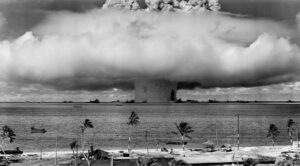
Across the Pacific, the legacy of past conflicts remains with us.
For some, those conflicts are history.
For communities living with UXO, that history is still present.
We often measure progress by the number of items found or cleared.
But I believe we must also ask:
What happens to the people?
What happens to the survivor?
What happens to the family?
What happens to their livelihood?
What happens to the community?
Victim assistance must go beyond emergency medical treatment. Survivors may need rehabilitation, psycho social support, accessibility, livelihoods, education, social inclusion and support for families and caregivers.
And this is where survivors must have a place in the conversation.
We should not be seen only as victims.
We are partners.
We are advocates.
And we are contributors to solutions.
The Pacific has an opportunity to learn from one another and from humanitarian frameworks such as the Mine Ban Treaty and other treaties, particularly in victim assistance, risk education, UXO clearance, international cooperation and support for affected communities.
For Solomon Islands, a State Party to the Mine Ban Treaty, the framework provides a foundation for continued learning and dialogue.
I am here to bring the survivor perspective.
And I am asking our Pacific neighbours and international partners to walk alongside me and Solomon Islands as well as with all other affected Pacific islands as we strengthen our response to UXO.
Because we should not have to make this journey alone.
My hope is that this dialogue will help us build a Pacific approach based on solidarity, partnership and shared learning—and ensure that survivors and affected communities are not simply people we speak about, but people we listen to and include.
I began BFSI because I survived.
But I do not want my story to end with my survival.
I want my experience to help create a safer future for others.
My story began with an explosion.
But I want it to end with hope.
And I hope that Solomon Islands’ journey can become part of a wider Pacific journey.
Because the people who live with the consequences must have a place in shaping the solutions.
Nothing about us, without us.
Thank you.
Learn more about Bomb Free Solomon Islands with this link to their Facebook page:
https://www.facebook.com/p/Bomb-Free-Solomon-Islands-61574977565288